


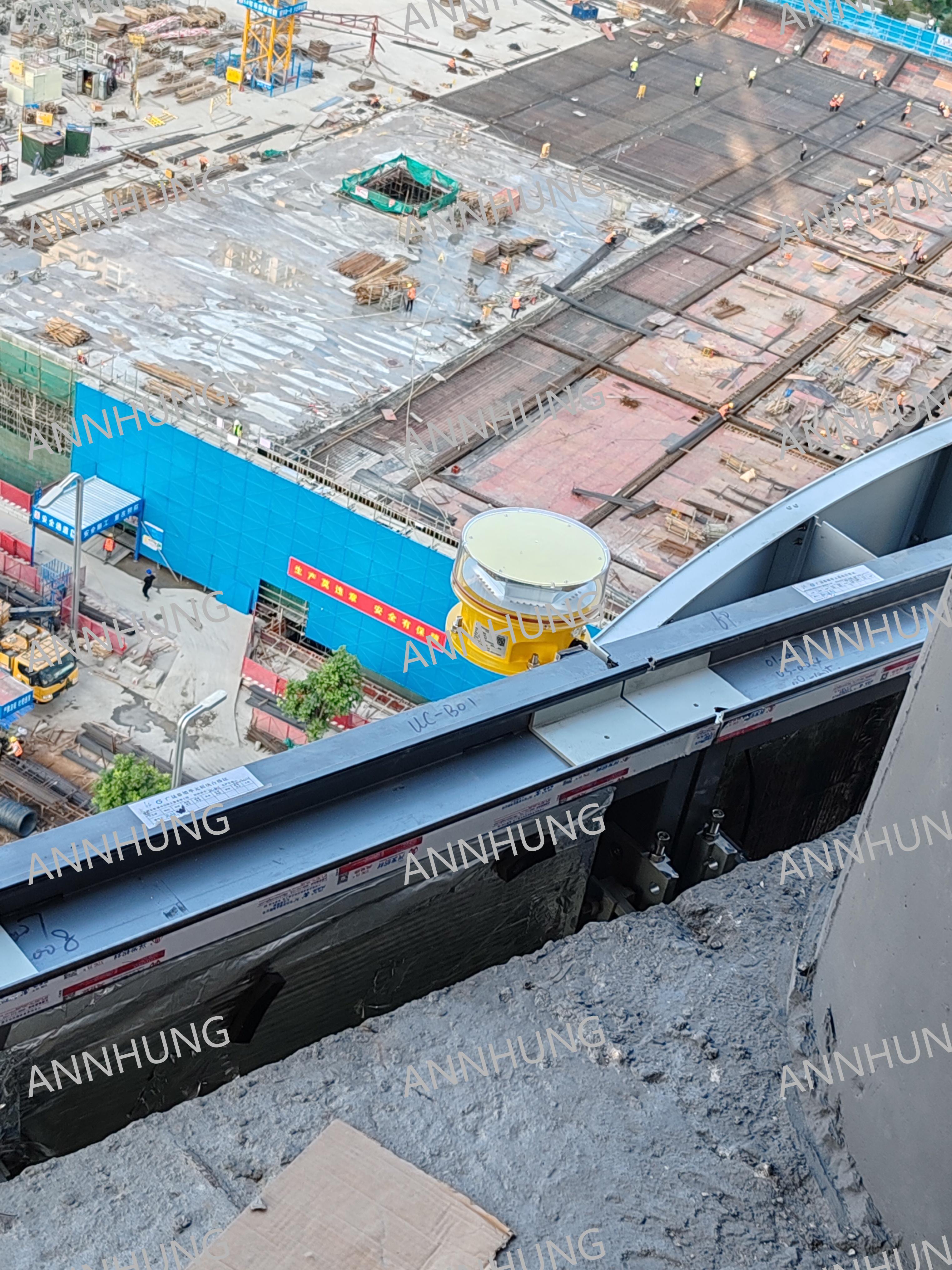
78 m High-Rise Residential Building Case: AH-MI-B2(L) Type B Red Obstruction Lighting for the Roof
Published On: November 27, 2026
Project snapshot: a 78 m, 24-storey high-rise residential building on China's southern coast needed ICAO-compliant obstacle marking across a crowded roof — parapet corners, the elevator machine room, the stair penthouse and two water tank platforms. Anhang Technology supplied AH-MI-B2(L) medium-intensity Type B red obstruction lights for the highest points, paired with low-intensity units at the intermediate levels.

Residential roofs are the hardest mounting surface
A commercial building gives you a clean machine room roof and a facilities team. A residential building gives you water tanks, solar water heaters, air-conditioning condensers, satellite dishes, a stair penthouse and residents who can see the roof from their own windows. The marking scheme has to respect all of it: the lights must clear every obstruction, must not spill light into bedrooms one floor below, and must be installed without disrupting water supply or lift service.
Height still decides the product. Under ICAO Annex 14 Volume 1, Table 6.3, structures in the 45–105 m band are marked with medium-intensity Type B red flashing lights at the top, with low-intensity lights at intermediate levels so no unlit gap exceeds the permitted spacing. China's CAAC MH6012-2015 and MH5001-2013 follow the same logic. On a 78 m residential roof, a Type B red unit is correct; a white Type A unit would over-light the whole neighbourhood.
Site conditions
- Height and exposure: 78 m roof plus a 5 m lift overrun — salt-laden air, wind-driven rain and typhoon-season gusts.
- Crowded roof: seven mounting positions across four parapet corners, two tank platforms and the elevator machine room, each needing a different bracket angle.
- No night staff: the property management office is unmanned after 22:00, so anything requiring manual switching would eventually be forgotten.
- Residents are the neighbours: bedroom windows sit 3 m below the parapet — light spill was the single biggest objection to manage.
The solution: AH-MI-B2(L)
A 2.5 kg red LED unit delivering ≥2,000 cd over a full 360° horizontal output with only 3° vertical divergence, flashing at 20–60 FPM (factory set to 20 FPM for Type B, with a steady mode for Type C duty). That narrow vertical beam is the point: the light goes out horizontally, where aircraft and pilots actually look, and not down into the apartments below.
| Parameter | AH-MI-B2(L) |
|---|---|
| Light source / colour | CREE high-intensity LED, red |
| Intensity | ≥2,000 cd, 360° horizontal, 3° vertical divergence |
| Flash | 20–60 FPM (Type B, factory 20 FPM); steady mode for Type C |
| Control | Built-in photocell, dusk-to-dawn automatic; surge and lightning protection |
| Power | AC 110–240V or DC 12/24/48V; 40 W instantaneous, ≤5 W average at 20 FPM |
| Body / base | UV-protected polycarbonate body, powder-coated die-cast aluminium base, vented to prevent condensation inside the lens |
| Dimensions / weight | 229×229×168 mm, 2.5 kg, mounting 190×190×Φ12 |
| Environment | IP66, wind 240 km/h, −55 °C to +55 °C, 10–95% RH |
| Compliance | ICAO Annex 14 Vol.1 Table 6.3 Type B/C; FAA L-864; CAAC MH6012-2015 |
| Options | Dry-contact alarm, RS485, GPS sync flashing, NVG infrared LED, bird spike, solar power system |
Installation on an occupied residential roof
Work was scheduled in a single day to avoid disturbing water supply. Units were fixed to 190×190×Φ12 bracket plates at the parapet corners and platform edges, cabled in galvanised conduit back to the rooftop distribution board, and aimed so the beam plane sits above head height on the roof terrace. Because each unit carries its own photocell, commissioning at dusk was simply a matter of energising the circuit and watching all seven units start together. The dry-contact alarm was wired to the property management office, so a dark unit now triggers a maintenance ticket instead of a resident complaint.
Results
- Compliance signed off first time: Type B band, spacing and 20 FPM rate matched the aviation authority checklist with no rework.
- No light-trespass complaints: 3° vertical divergence kept output off the bedroom windows below — the objection that usually kills residential retrofits.
- Negligible running cost for the property manager: ≤5 W average per unit at 20 FPM across seven units.
- Weatherproofing held: IP66 bodies with vented bases rode out two typhoon-season storms with no internal condensation.
Takeaway
For high-rise residential buildings in the 45–105 m band, the AH-MI-B2(L) answers both audiences at once: 2,000 cd of Type B red for the aviation authority, and a horizontally converged, self-switching, alarm-ready light that keeps residents undisturbed. Add low-intensity units on the lower levels and the building is marked to ICAO and CAAC standards with one product family.

