


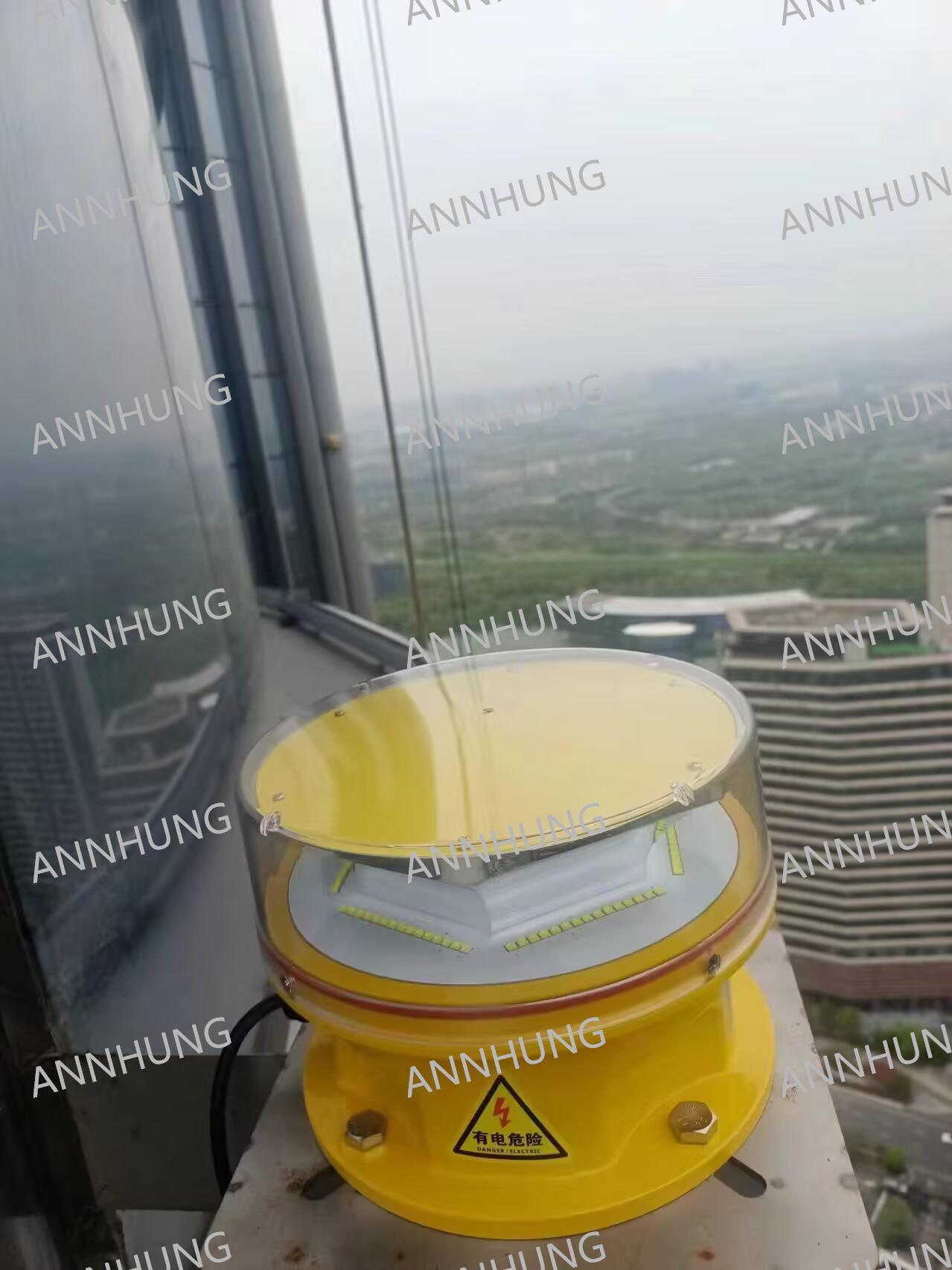
128 m High-Rise Residential Building Case: AH-MI-A2 Type A White Obstruction Lighting, 24-Hour Duty
Published On: November 27, 2026
Project snapshot: a 128 m, 40-storey high-rise residential building in a humid inland city sits under a published approach path. Its parapet corners, roof machine room and two elevator overruns required medium-intensity Type A white obstruction lighting operating 24 hours a day. Anhang Technology supplied the AH-MI-A2, with medium- and low-intensity units on the levels below to complete the marking scheme.

Above 105 m, the rules change — including for housing
Under ICAO Annex 14 Volume 1, Table 6.3, structures in the 105–150 m band are marked with medium-intensity Type A white flashing lights. The decisive word is "day": a red Type B light is a night marker, while a Type A light must also be visible in daylight haze against a bright sky — which is why the photometric requirement jumps by ten times, to 20,000 cd.
For a high-rise residential building the challenge is different from a commercial one. Nobody is on the roof to switch anything, residents cannot be relocated during works, and the building services (water tanks, lift machine rooms, satellite dishes) already occupy every square metre of the roof.
The engineering requirement
- Dual-mode photometrics: ≥20,000 cd by day and ≥2,000 cd by night, switched automatically — 24 hours, no sleep mode.
- Layered marking: Type A at the top, medium- and low-intensity lights at intermediate levels at the spacing the code requires.
- Roof congestion: units placed to clear water tanks, aerials and lift overruns without shadowing each other.
- Residential tolerance: 3° vertical divergence so the daytime beam does not reach balconies on the floors below.
- Property-management reality: a fault signal at the management office instead of a monthly roof climb.
The solution: AH-MI-A2
A 3.5 kg white LED obstacle light with a UV-protected polycarbonate reflector and die-cast aluminium base, delivering ≥2,000 cd at night and ≥20,000 cd in daylight across 360° with 3° vertical divergence and a 20–60 FPM flash (factory set to 20 FPM). Average consumption is ≤13 W at 20 FPM against a 600 W instantaneous peak — the number that matters when the light runs 24/7 for a decade.
| Parameter | AH-MI-A2 |
|---|---|
| Light source / colour | CREE high-intensity LED, white |
| Intensity | ≥2,000 cd (night), ≥20,000 cd (daytime), 360°, 3° vertical divergence |
| Operation | 24-hour, two automatic modes (day / night) |
| Flash | 20–60 FPM, factory set 20 FPM |
| Power | AC 110–240V or DC 12/24/48V; 600 W instantaneous, ≤13 W average |
| Body / base | UV-protected polycarbonate, powder-coated die-cast aluminium, vented base |
| Dimensions / weight | 229×229×168 mm, 3.5 kg, mounting 190×190×Φ12 |
| Environment | IP66, wind 240 km/h, −40 °C to +55 °C, 10–95% RH |
| Compliance | ICAO Annex 14 Vol.1 Table 6.3 Type A; FAA L-865; CAAC MH6012-2015 |
| Options | Dry-contact alarm, RS485, IOT monitoring, NVG infrared LED, bird spike |
Installation notes from a working residential roof
Units were fixed to 190×190×Φ12 bracket plates at the four parapet corners, the roof machine room and both lift overruns, with cable runs in galvanised conduit to a rooftop junction box fed from the building's common-area supply. Two checks were added because the light runs around the clock: daytime output was verified from a neighbouring high-rise 2 km away on a hazy afternoon, and the vented base was inspected after a week of 90% humidity to confirm no fogging inside the lens. The RS485 / dry-contact option reports status to the property management system.
Results
- Visible in daylight at 2 km: the 20,000 cd day mode met the requirement that defeats cheaper night-only units.
- Predictable running cost: ≤13 W average per unit for continuous duty — a few units cost less to run than the roof's corridor lighting.
- No condensation or lens fogging through a humid subtropical summer, thanks to the vented base and IP66 sealing.
- Maintenance moved to the management office: alarm and RS485 feedback replaced physical roof inspections with a status point on screen.
- Residents unaffected: the 3° vertical beam kept daytime output above the parapet line.
Takeaway
Past roughly 105 m, marking a high-rise residential building stops being "a light on the roof" and becomes a 24-hour photometric system. The AH-MI-A2 covers that band with 20,000 cd daytime output, 2,000 cd at night, automatic dual-mode switching and monitoring interfaces — ICAO Type A and FAA L-865 compliant, designed to work with medium- and low-intensity lights on the levels below.

